Competition gymnastics leotards: a buying guide


Choosing a gymnastics leotard for competition starts with one precise rule: the base of the shoulder must be fully covered, or the gymnast risks a deduction from her execution score. In practice, this technical requirement shapes the pattern long before any decision about fabrics. Keeping it in mind makes the choice of leotard a safe one when kitting out your gymnasts for a whole season.
Choosing a competition gymnastics leotard
A competition leotard needs flat seams and lycra of at least 190 g/m² to withstand friction on the apparatus. This level of demand sets it firmly apart from a training gymnastics leotard, where the finish allows far more tolerance. High-level gymnastics forgives no distortion of the fabric under tension.
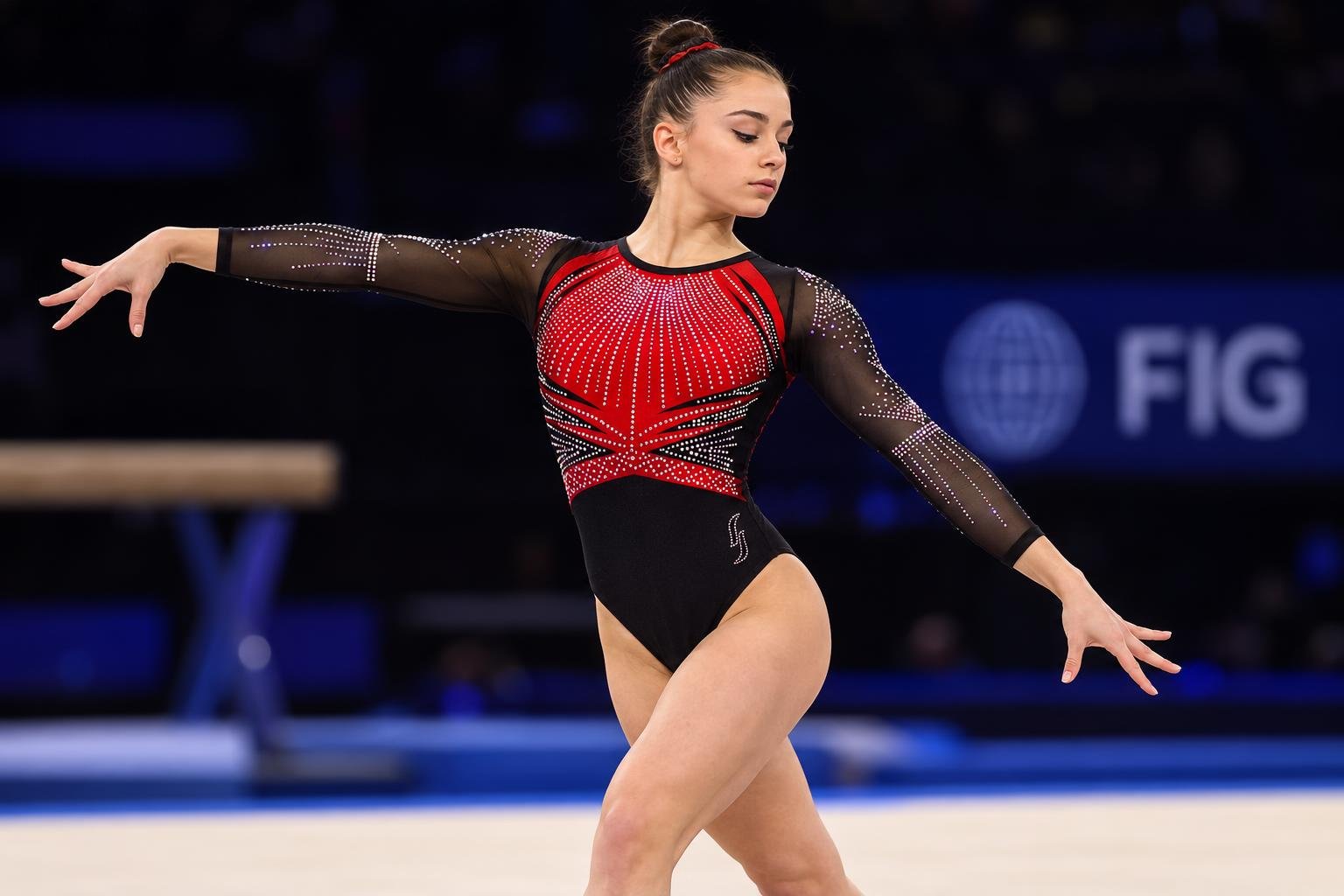
FFGym rules your gymnastics leotard must meet
An equipment check by the judges immediately penalises any cut that does not meet federation standards. That is why a competition leotard requires strict armholes. In practice, a sleeveless leotard with thin straps exposes the gymnast to a dispute before she even steps onto the floor.
- Sleeves required: I favour short sleeves, 3/4 cuts or long sleeves so the gymnast can compete on every apparatus without risk.
- No see-through fabric: the main body must stay opaque, with mesh reserved for the arms under artistic gymnastics rules.
- A covered back: we deliberately limit the back opening to avoid any penalty in gymnastics competitions.
- A controlled neckline: a neckline that plunges too low leads to a deduction, so the chest line has to be raised right from the pattern stage.
A long-sleeved leotard effectively keeps the gymnast's muscles warm in cold sports halls. This leotard with sleeves design removes any risk of breaching the shoulder-coverage rule. It is the construction I recommend first and foremost for winter competitions.
Fabrics, rhinestones and design to shine in competition
To build a high-performing girls' artistic gymnastics leotard, four-way stretch lycra guarantees complete freedom of movement with no bagging at the elbows. Below a certain fabric weight, the material thins and stretches out after a few intense sessions. The durability of the leotard depends directly on that initial density.
Embellishments need to be set with a cold resin to withstand constant rubbing on the landing mats. A quality leotard keeps its rhinestones for the whole sporting year when the fixing method in the workshop is flawless. The real difference lies in abrasion resistance.
Sharp contrasts, such as deep black paired with red, or a vibrant purple, make the lines of the body easier to read. The fabric design guides the judges' eyes towards the precision of each movement.
Girls' artistic gymnastics leotards: styles and customisation
The Startner workshop makes the Reinette, Rebecca and Roxane lines with topstitching designed to neutralise friction points. These leotard styles are built with tension suited to the extreme pulling forces of the uneven bars. The mixed Roma and PERLE cuts offer the same answer for clubs dressing mixed squads.
Club customisation includes careful colour matching and the club badge integrated directly into the fabric. The Valentine 03 competition leotard illustrates this approach with its structured collar and sparkling embellishments. With the same rigorous cut, the Toscane 04 competition leotard is a solid choice for a high-level routine.
| Style | Main colours | Sleeve type | Recommended use |
| Valentine 03 | Neon green / white / black | 3/4 mesh, high neck | Competition, gala |
| Toscane 04 | Black / red | 3/4 sheer mesh | High-level competition |
| Roma / Rubby / PERLE | Customisable | Made to measure for clubs | Competition, training |
Size, fit and accessories for competition day
Grading sizes for young gymnasts calls for millimetre precision around the armhole from the age of 3. A well-sized gymnastics leotard follows the back through hyperextension without cutting into the underarms. That balance is what optimises acrobatic performance throughout the routine.
Grips and skin-coloured bandages are the only extra equipment allowed without a deduction. For a secure hold, chalk remains the essential technical complement to the leotard. Our competition leotard range brings together our Marseille-made pieces, ready to equip your club with garments cut for physical stress.
Recommended products
Frequently asked questions
Federation rules exclude thin straps and the sleeveless leotard from the competition floor. In practice, short sleeves must cover the shoulders, although long sleeves remain the safest option. The body of a competition leotard must be fully opaque: a completely open back leads to an immediate penalty.
In the workshop, the pattern of a competition leotard is checked against four measurements: chest, waist, hips and torso length. A good leotard follows the figure without squashing the shoulders or riding up as the gymnast moves. If in doubt between two sizes, I recommend the larger one: too much tension restricts movement and weakens the seams of the gymnastics leotard.
A long-sleeved leotard for competition features heat-applied rhinestones, which do not cope well with the daily washing that gymnastics demands. A training gymnastics leotard, on the other hand, relies on thick matt lycra with a simple round neck, ensuring the durability of a garment worn every day. The difference comes down to priority: visual impact for competition, versus resistance to heavy friction for training.
Share this article: