Shiny gymnastics leotard: how to choose the right one


A shiny gymnastics leotard must fit properly, suit the discipline and match your needs in terms of material, design and price. What matters most: the right measurements, a suitable shiny fabric, the competition rules of your discipline and the price. Startner makes its models in Marseille.
Which size fits a shiny gymnastics leotard?
In gymnastics, a leotard fits close to the body. That is why your usual clothing size alone isn't decisive; what counts is the combination of several body measurements. Taking them carefully before ordering saves you corrections later.
Comparing sizes for girls and women
For a gymnastics leotard for girls or women, height and chest, waist and hip measurements all count. Height alone isn't enough: two people of the same height can differ noticeably in torso length and shoulder width.
- Chest: measure horizontally at the fullest point, breathe normally and don't pull the tape measure tight.
- Waist: measure at the natural waist, not at trouser waistband height.
- Hips and height: hips at the widest point, height without shoes.
- Torso length: following the manufacturer's instructions, run the tape measure over the shoulder and down the torso to the crotch and back.
Torso length deserves particular attention with close-fitting models. If it is too short, it can restrict freedom of movement, and even a very stretchy fabric won't reliably make up for that.
Startner offers sleeveless models in children's sizes from 4 to 14 years and women's sizes from 36 to 46. However, only each model's size chart shows whether a gymnastics leotard fits a child or an adult: check your measurements against it before you order.
Checking the fit in motion
A shiny leotard should fit close to the body without pinching. The difference shows when you move: the neckline, straps and leg openings must stay in place during jumps and turns.
- Raise your arms fully: with the upper body stretched, the leotard mustn't pull at the crotch.
- Lunge: the fabric shouldn't dig in or turn see-through when stretched.
- Shoulders: fabric that stands away from the body suggests the leotard is too big.
- Crotch and seams: noticeable creases, or seams and decorations that rub, point to a poor fit.
In practice, this means: if possible, try the leotard on with the underwear you plan to wear and with movements from your discipline.
Short sleeves or sleeveless for girls?
Depending on the model, leotards for girls come sleeveless, with short sleeves or with long sleeves; the sleeve style alone doesn't determine whether a leotard is suitable for competition. A sleeveless cut leaves the shoulders and arms free, giving freedom of movement on the uneven bars, beam and floor, for example with models from the collection of sleeveless leotards with rhinestones.
Sleeves are preferable when the arms should be covered, for example in a cold gym or at a gala. Whether you choose short or long sleeves then depends on the occasion.
Tip
The right size for shiny leotards
Take several body measurements carefully before ordering. Your usual clothing size alone isn't decisive, because the leotard fits close to the body during training.
Where does a gymnastics leotard's shine come from?
A leotard shines in two places: the base fabric and the decoration. Judge the two separately, because an eye-catching effect says nothing about stretch or durability.
Comparing Lycra, elastane and velvet
A shiny base fabric reflects light from its surface. Lycra, in other words elastane, mainly provides stretch and recovery in a blended fabric, not automatically more shine. Blends of polyamide and elastane or polyester and elastane are common; the fibre type alone doesn't give a ranking for shine or durability.
Velvet looks smooth and soft, whereas a metallic or foil look comes from a surface treatment. Product photos only show this to a limited extent: for velvet and effect fabrics alike, it is better to compare fabric samples for stretch, recovery and opacity under bright light.
Leotards with glitter, rhinestones and colour gradients
On a leotard with lots of sparkle, the effect usually comes from the embellishment: rhinestones create points of light, while sequins create moving reflections. A colour gradient, on the other hand, is a design element and not proof of fabric quality.
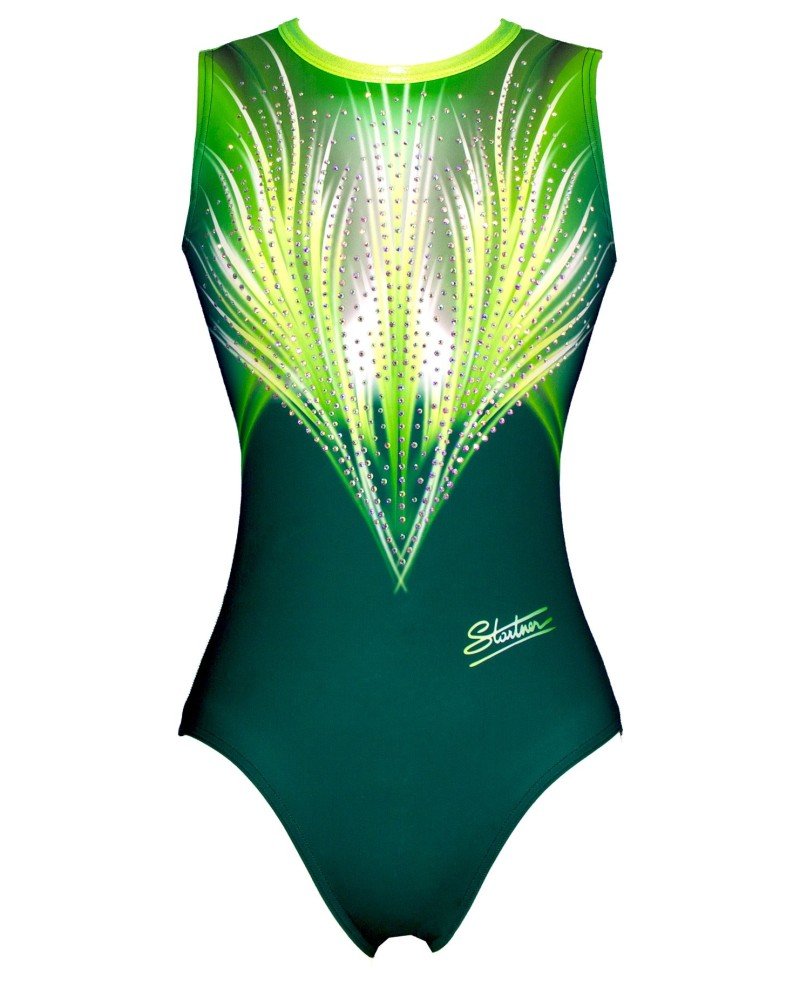
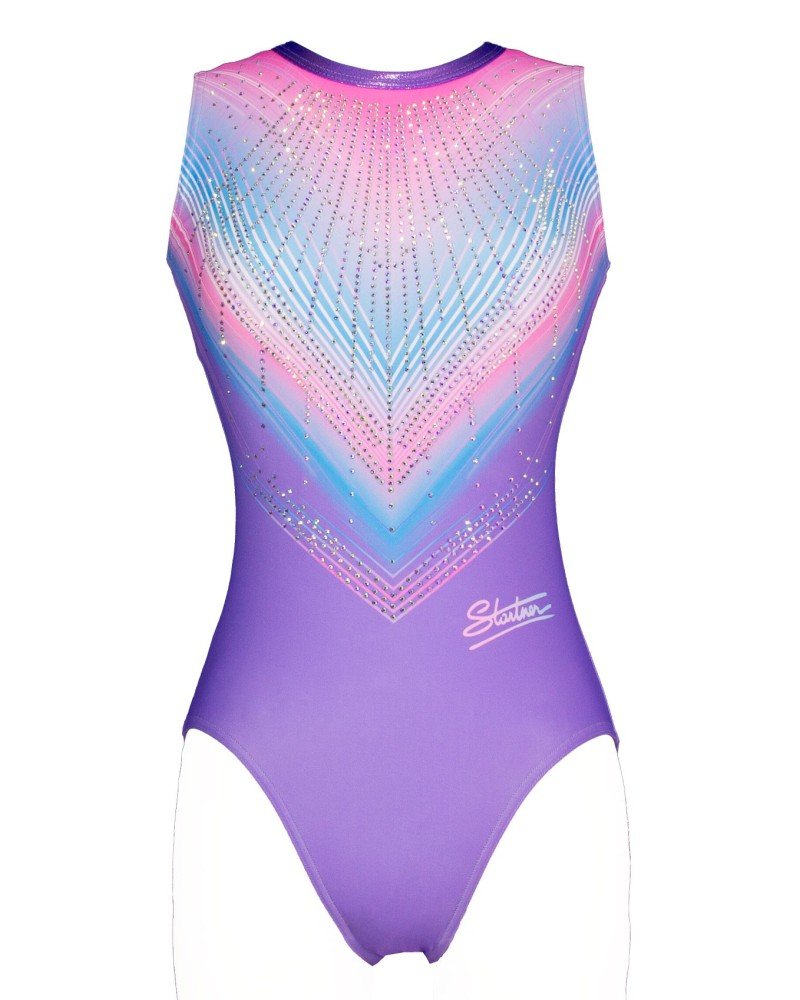
Two models show how these elements can be combined. The Azure-02 pairs fir green and emerald green with a ray motif running towards the waist, hundreds of rhinestones on the front and a shiny lime-green trim, as described on the product page of the green Azure-02 leotard. The Aria combines pink, light blue and lilac with rhinestone rays on the chest and a teardrop-shaped back opening.
Checking the finish and care of the decoration
Whether a sparkly gymnastics leotard stands up to everyday use depends on how it is made. Look out for the following points:
- Seams: even, elastic and flat at the crotch, armpits and sleeve seams; a seam that is too stiff gets in the way despite the stretchy material.
- Edges: neatly bound, with no loose seam ends.
- Rhinestones: firmly attached, with no protruding edges and no hard spots inside, especially in areas under heavy strain.
For care, follow the model's label. Instructions range from hand washing to a gentle machine wash at 30 °C maximum, sometimes inside out and in a laundry bag.
Recommended products



Is a shiny gymnastics leotard suitable for competition?
Shine alone doesn't make a leotard suitable for competition. In training, what counts is a secure fit, freedom of movement and easy care; in competition, the rules of the discipline come on top.
Why doesn't a ballet leotard replace checking the rules?
A ballet leotard is designed for dance and ballet and can differ in cut from a gymnastics leotard. Product names don't guarantee anything either. Three levels are decisive:
- Discipline: artistic gymnastics and rhythmic gymnastics follow different rulebooks.
- Competition rules: they set out what applies at each competition.
- Club requirements: a club can require everyone to wear the same model.
The term “gym bodysuit” refers to a close-fitting bodysuit but, like a ballet leotard, does not confirm that it complies with federation rules.
Rhythmic gymnastics rules
The 2025–2028 Code of Points for rhythmic gymnastics requires close-fitting clothing and material that is opaque or lined from the chest to the crotch. Sleeveless models, narrow straps, sleeves of any length and full-length tights worn over or under the leotard are allowed; shorts and half-length tights are not.
Appliqués are permitted as long as they lie flat and are safe. Under this code, non-compliant clothing costs 0.30 points, so check which version applies to your competition before buying.
What makes a good shiny leotard
- Secure fit and freedom of movement in training
- Easy care for fabric and decoration
- In line with the rules of the discipline
- Stretch and recovery thanks to elastane in the fabric blend

How much does a shiny leotard cost?
The price range is wide, and it is explained by material, cut and decoration. Price alone, however, proves neither quality nor suitability for competition.
Prices for children's and women's models
A simple shiny children's leotard starts at around €17.99. A girls' leotard with sequins and rhinestones costs about €34.99, and a long-sleeved rhinestone model €39.99. Other shiny models reach €49.00; these examples don't add up to a general market price.
- Material and cut: the type of fabric and sleeves changes the amount of work.
- Decoration: rhinestones and colour gradients can increase the design work.
- Personalisation: club colours and one-off production come on top.
Startner's sleeveless Azure-02 and Aria models cost €65.00 each. As a sparkly leotard for women and children, the Aria is available in children's sizes from 8 to 14 years and women's sizes from 36 to 40, as shown on the Aria leotard product page.
| Model type | Price |
| Simple shiny children's leotard | €17.99 |
| Model with sequins and rhinestones | €34.99 |
| Long-sleeved rhinestone model | €39.99 |
| Other shiny model | €49.00 |
| Startner Azure-02 / Aria (sleeveless, rhinestones) | €65.00 |
Club orders and personalisation
Startner designs and makes its sleeveless leotards in its own workshop in Marseille and also offers the Azure-02 and Aria for whole teams in club colours. Plan ahead for taking sizes, a uniform design and repeat orders: later deliveries may differ in fabric batch, colour or decoration.
For made-to-measure orders, agree in writing who checks the measurements and how sizing errors will be corrected.
Calculating import costs before ordering
If you are comparing a single or imported order, factor in shipping, any import duties and handling fees as well as the price of the item. Import VAT may be charged on goods imported from outside the EU.
Since 1 July 2026, a simplified customs duty has applied in the EU to certain e-commerce parcels worth up to €150. It amounts to €3 per category of goods and is, in principle, paid by the retailers or importers responsible for the customs declaration.
Shiny gymnastics leotards direct from the manufacturer
Since 1968, we have been making gymnastics wear in Marseille for clubs and individuals. Discover our shiny models.
Frequently asked questions
Without details of the material, how they are attached and how the leotard is cared for, no general lifespan can be given. Friction or unsuitable detergents can loosen individual stones, and decoration can catch on bags or Velcro fastenings. If the product information doesn't say how they are attached – glued or otherwise – ask.
Check how far the effect fabric stretches and whether it is designed for frequent washing and intensive movement. Also look out for scratchy surfaces, stiff foil areas and rough seams, and, on coated surfaces, for cracks, flaking and colour changes.
For training, Startner recommends a simple, hard-wearing sleeveless leotard that can handle frequent washing, and for competitions a more elaborate model with rhinestones or colour gradients. Before a competition, check the federation's rules and your club's requirements, as a club can require everyone to wear the same model.
Share this article:




Similar posts
What should a child wear for gymnastics? A guide by age
Leotard, shorts or fitted leggings: how to dress your child for gymnastics according to their age and discipline, and which accessories to pack.
Gymnastics leotard size chart: EU to US and UK conversion
Convert European gymnastics leotard sizes to US and UK sizes, with a chart in inches and tips to measure your gymnast and choose between two sizes.