Knickers under a gymnastics leotard: should you wear them?


No general rule requires knickers under a gymnastics leotard: the decision depends on how opaque the outfit is, the gymnast's comfort and the rules of her discipline. Here we explain when to go without, which cut and colour stay discreet, when to switch to period protection and what is allowed in competition.
Should you wear knickers under a leotard?
In practice, the answer depends less on habit than on the leotard itself. A well-made leotard can be enough on its own, and an extra layer only meets specific needs. The choice is therefore made case by case, gymnast by gymnast.
When can you go without?
An opaque, well-lined, well-fitting and comfortable model can be worn directly against the skin, with no underwear lines.
- Opacity : the fabric reveals nothing, even when stretched.
- Lining : the leotard is properly lined.
- Fit : the leotard stays in place without squeezing or gaping.
Worth knowing: knickers should never be used to make up for a see-through or unsuitable leotard. If the fabric shows the skin, it is the leotard that needs changing.
When does an extra layer help?
Thin knickers can meet a personal preference or help manage vaginal discharge, without being necessary for every gymnast. What matters here is the purpose: ordinary knickers, a seamless model and period protection do not do the same job, and none of them alone guarantees no lines or discomfort.
The upper body is a different need. Startner offers a gymnastics crop top to wear under the outfit or on its own, which in no way replaces knickers.
What helps with comfort?
Thin, stretchy, breathable, well-fitting knickers limit the extra bulk under a close-fitting outfit. Elastane, a stretch fibre, helps fabric regain its shape after stretching, without guaranteeing breathability or comfort on its own.
Seams, labels, elastic and finishes can cause chafing for a sensitive gymnast. The word “hypoallergenic” does not guarantee there will be no reaction: for sensitive skin, look first at the composition and finishes.
Which knickers stay discreet and secure?
The least visible cut is not always the one that stays in place best. Under taut lycra, an edge or elastic can show: discretion is therefore judged on cut, colour and how well they stay put during movement.
Comparing cuts under the leotard
High-leg knickers can stay hidden, as long as their leg line matches that of the leotard, including during splits. Compare the two edges against each other before buying.
Classic knickers with fine seams can show their elastic or seams under taut fabric. A cut without thick seams reduces some ridges, but its edges can still show or roll.
Boy shorts cover more but can ride up the thigh. A tanga or thong can reduce lines at the back, at the cost of chafing or shifting during splits.
Choosing a colour to suit the fabric
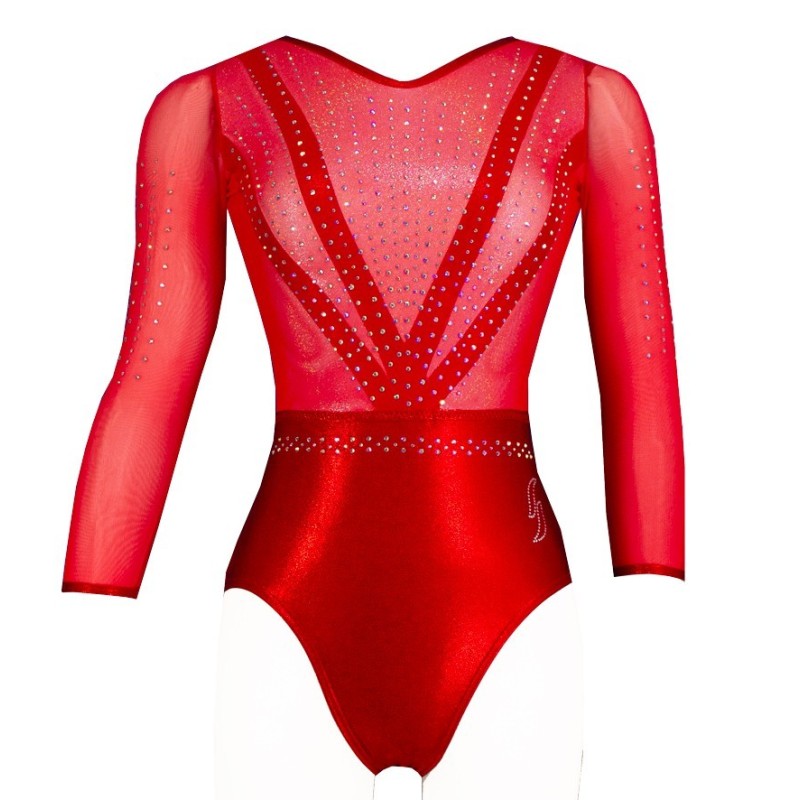
Under skin-tone mesh, white or a bright colour can stand out. A shade close to the skin can be more discreet, but skin tone is not universal: it depends on each gymnast's complexion.
Under a light-coloured leotard, compare a shade close to the skin, a light shade and a matching shade. Under a dark leotard, a colour close to the garment contrasts less. A skin-tone bodysuit, for its part, is a one-piece garment, distinct from knickers.
Checking they stay in place during movement
Knickers that are invisible when standing can show at the first split. In practice, the test follows the movements of a session, from putting the leotard on to rotations.
- Putting it on : the gusset lies flat, the edges do not roll and do not dig painfully into the skin.
- Splits and lunges : the seams and crotch do not pull.
- Bends and jumps : the waistband does not roll and no folds form.
- Rotations : no edge shows outside the leotard.
Finish with a check from the front, back and side under bright lighting, which reveals outlines that are invisible at rest. A young gymnast can do this check herself, with her privacy respected.
When should you choose period protection?
During a period, the question changes: it is no longer just about discretion but about protection. What makes the difference here is an area designed to absorb.
Telling ordinary knickers and protection apart
Ordinary knickers do not protect against menstrual flow. Period pants have an absorbent area designed for this purpose, which can serve as main or back-up protection depending on the product and the flow.
Ordinary gymnastics tights do not have this function. They only become period protection if an absorbent area is built in and explicitly stated.
Assessing absorbency and fit
The choice depends on flow, session length, comfort and whether it is possible to change; check the stated capacity and the area actually protected. This area can be thicker, warmer and more visible than thin knickers. It must stay against the body, with no folds or compression: a gusset that is too narrow or a size that is too big can lead to leaks.
Testing protection before the event
A stated capacity does not guarantee a number of leak-free hours during acrobatics. According to the French consumer association UFC-Que Choisir, the drops shown on packaging do not correspond to a standardised absorption capacity. Period pants or a period under-leotard intended for competition should first be tried during a full training session, with spare protection.
A pad can shift during acrobatics, whereas internal protection adds no layer under the outfit. For tampons, the French national health insurance (Assurance Maladie) recommends changing every 4 to 6 hours maximum.
What do competition rules allow?
The rules mainly cover the outfit itself. The requirements concern opacity and fit, without requiring extra knickers.
Underwear and tights
The French Gymnastics Federation's adapted rhythmic gymnastics code 2025-2028 requires opaque fabric over the pelvic area and buttocks of the competition outfit.
The same code allows tights worn over or under the leotard. That does not mean it approves any visible underwear.
- Opacity : required over the pelvis and buttocks.
- Tights : allowed over or under the outfit.
- Visible underwear : not automatically approved.
- Compulsory purchase : none for knickers, ordinary or period.
Conditions for wearing shorts
Since 20 January 2025, the French Gymnastics Federation has allowed, under conditions, short shorts worn over the outfit. They must be stretchy, opaque, fitted, plain or matching the leotard, not skin-coloured, and measure 10 cm maximum from the crotch.
These shorts are not worn with a unitard. In group events, shorts must meet the federation's uniformity requirements.
Confirming the outfit before competing
The discipline, season and level determine which rules to check. If in doubt about protection or visible underwear, the club decides.
Startner offers plain shorts to wear over the outfit, whose use in competition remains subject to the applicable rules.
Startner also offers rhinestone shorts to go with the outfit. Their decorations need careful handling when washing, and their compliance should be checked before each competition.
Frequently asked questions
No. A size that is too small can make lines and chafing worse instead of flattening the knickers. Elastic that rolls, squeezes or leaves painful marks means the fit is wrong.
It is possible, but not without trying it first: an adhesive pad or second layer can create a ridge and discomfort and affect stability during exercise. A pad is easy to change, but it can shift, crease or rub during acrobatics.
Under mesh, check both the colour and the outline of the underwear. A shade that is discreet on the skin can remain visible, especially if the fabric is very light, shiny or more see-through when stretched.
Share this article: