Women's full-body gymnastics leotard: fit, fabric and rules


A women's full-body gymnastics leotard has to suit your body, your discipline and how you plan to use it. What matters most is the cut and style, accurate body measurements, the choice of fabric between Lycra, elastane and polyester, and the clothing rules set by the German Gymnastics Federation (DTB) and the FIG. Here is how to choose a leotard that is comfortable in training and allowed in competition.
Which full-body leotard suits the way I train and compete?
The right leotard depends on what you need it for. The cut, sleeve length and design vary from one discipline to another, and in a club the team's shared look also comes into play.
How does a full-body leotard differ from a classic leotard?
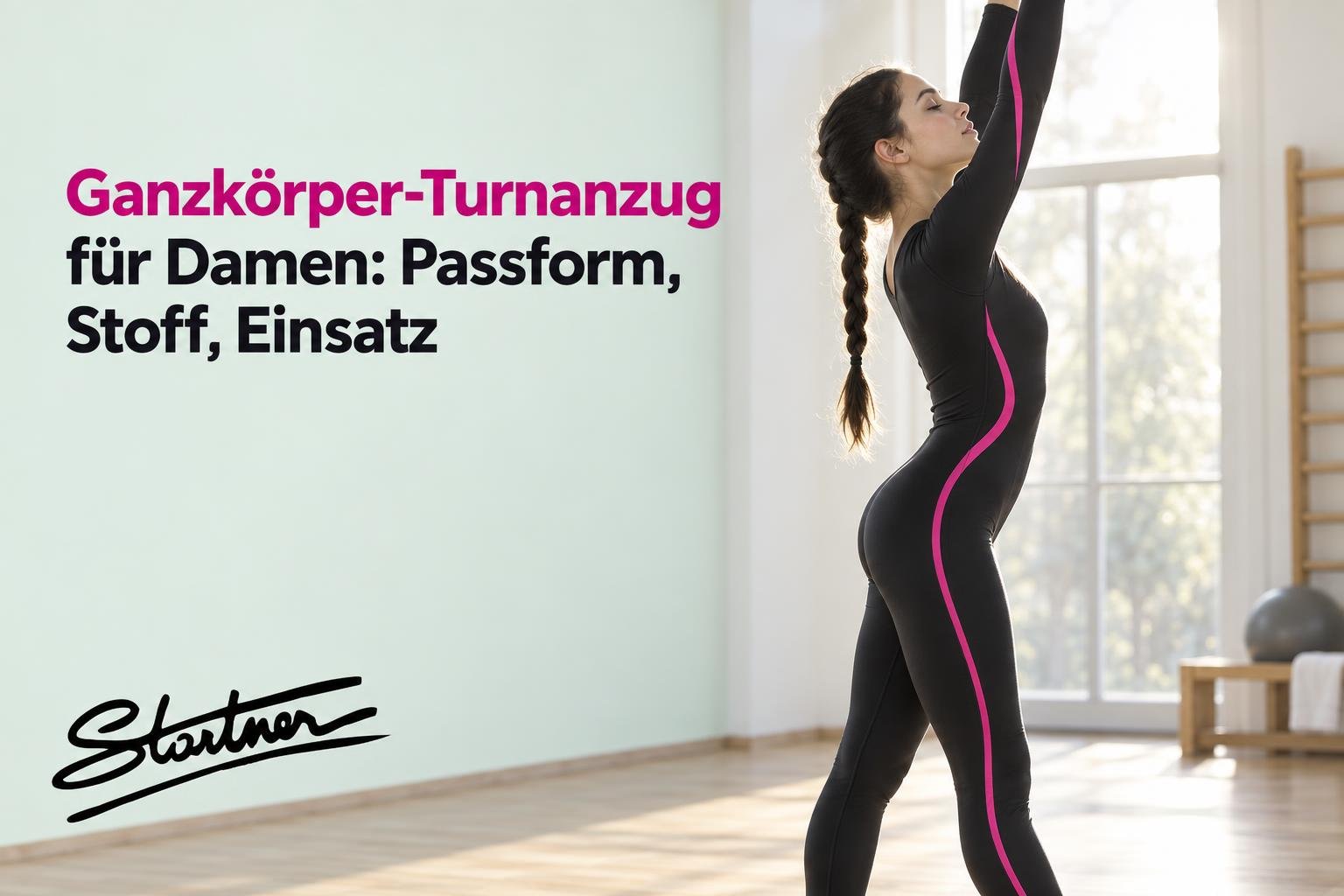
A full-body leotard (often called a unitard) is a close-fitting one-piece with legs. A classic gymnastics leotard, by contrast, stops at the leg opening. In DTB artistic gymnastics, the full-body leotard is defined more precisely: its legs run from the hip to the ankle, so the whole leg line stays covered.
Shops do not all use the same terms. Anyone looking for a women's gymnastics leotard will therefore come across several names for very similar garments:
- Leotard and gym leotard: the two terms are often used interchangeably.
- Bodysuit: often refers to a dance or ballet body and is not a term used in competition rules.
- Unitard: common, but a less precise way of describing the garment.
- Leotard: the English word for a one-piece gymnastics suit, also used in German-speaking countries.
None of these names defines the cut or whether a garment is allowed in competition, whether it is called a bodysuit or a unitard. Women wear gymnastics leotards in artistic gymnastics, rhythmic gymnastics and acrobatic gymnastics, among other disciplines. Startner makes gymnastics leotards and gym suits in France.
Which cuts and styles can I choose from?
Leotards come sleeveless, with short sleeves or with long sleeves. A leotard with long sleeves and long legs covers more skin when you are in contact with the apparatus. In a cool gym, a long-sleeved leotard is also more pleasant to wear. This cut works equally well for training and competition, provided it meets the requirements of the event in question.
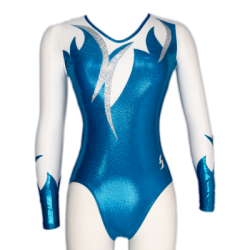
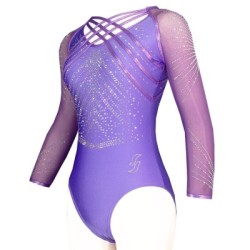
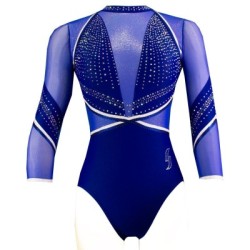
Startner makes its long-leg gymnastics leotards for girls and women from sublimated Lycra. They are designed for training, competition and displays in artistic gymnastics. One blue design has white accents and rhinestones on the front. The red PHILIPINE-02 design has tulle inserts at the shoulders and straps that meet at the back.
What matters for training and club displays?
For training, the key is a close-fitting cut that moves with you through big movements. The rules of official competitions do not automatically apply there. Calling a garment a "competition leotard" does not prove it is permitted. Before you use it, check the discipline, the federation and the entry rules of the specific event.
Clubs often coordinate colours and design for a unified look. Startner customises its range of full-body gymnastics leotards in club colours, in the same way as its classic leotards.
How do I find the right size and fit?
Gymnastics leotards are cut differently from everyday clothes, so your usual dress size is not enough to go on. Instead, compare your own body measurements with the size chart for the style you want.
Which body measurements do I need to take?
The basics are height and chest, waist and hip measurements. For a one-piece with long legs and sleeves, you will need a few more:
- Height: measure standing up straight, from the top of the head to the soles of the feet.
- Chest and waist: measure the chest horizontally at its fullest point under the arms, and the waist at its natural position.
- Hips: measure horizontally around the fullest part of the bottom and hips.
- Girth, inside leg and arm: measure the torso girth from the shoulder point down through the crotch and back up to the shoulder, plus the inside leg and arm length.
Torso girth is especially important for a full-body leotard. It tells you whether the one-piece is the right length or will pull at the crotch.
How do I read the size chart?
Take your measurements without pulling your stomach in, ideally wearing the underwear you will later wear under the leotard. If your chest and hips fit but your torso girth is well outside the size chart, a longer or different cut may suit you better than a bigger dress size. There is no universal conversion into XS, S or M.
The standard DIN EN 13402-3:2017-12 defines clothing sizes by body measurements and size intervals, not by the measurements of finished garments. According to this reference, a chest measurement of 84 cm corresponds to German size 36. Your other measurements still need to match the product's size chart.
How can I tell if it fits well?
A good fit sits close to the body and neither digs in nor rides up when you move. If the leotard is too tight, it pulls at the neck or crotch and the seams are visibly strained.
Horizontal creases when you stretch, a neckline that gapes, or edges that do not slide back into place after a movement all show that a leotard is too loose. More fabric does not automatically mean more freedom of movement, because excess fabric shifts around.
In practice, this means: when trying it on, stretch your arms above your head, go into a deep squat, then do a lunge, a forward bend and a few jumps. Afterwards, the leotard should sit properly again. At the crotch, underarms, shoulders and leg openings, the seams should stretch with you without opening.
Recommended products
Which fabric is best for a gymnastics leotard?
The fibre content on the label only tells part of the story. How a leotard feels to wear also depends on how the fabric is constructed and how the garment has been made.
What do Lycra and elastane mean?
Elastane is a stretch fibre. It keeps close-fitting sportswear stretchy and helps it spring back into shape. LYCRA® is a brand name for elastane fibre technologies, not a separate type of fibre. Examples of blends:
- Stretch sports fabric: 82% polyamide and 18% elastane.
- Velvet: 87% polyamide and 13% elastane. Here, velvet describes the surface or construction of the fabric, not a fibre.
- Leotard fabric: 87% polyester and 13% elastane.
A high elastane content alone does not make a fabric more breathable. Nor does it guarantee that the leotard will keep its shape better after washing.
Which fabric feels comfortable in training?
Whether a fabric breathes does not depend on the fibres alone. Construction, density, coating, lining and cut all play a part too. The percentages on the label are therefore not a measure of breathability.
Polyester absorbs relatively little moisture. But how well a fabric actually wicks away sweat is also determined by its construction and finish. For long sessions, moisture wicking and air circulation are particularly important.
The difference becomes clear when you compare fabrics side by side: stretch the fabric in both directions and watch how it springs back and whether it becomes see-through. The stretch of the seams and the way the edges sit are just as telling.
How do I care for and check the fabric?
Many gymnastics leotards are washed at 30°C maximum or on a delicate cycle, but the care label is what counts. Wash embellished designs by hand or in a laundry bag, with no tumble dryer, iron or fabric softener. Under EU Regulation 1007/2011, fibres and their percentages by weight must be listed in descending order. Under REACH, certain azo dyes must not release more than 30 mg/kg of aromatic amines. OEKO-TEX® is an additional, voluntary certification.
Is a full-body leotard allowed in competition?
In principle, yes, but with rules on straps, neckline and leg cut. Which rules apply depends on the federation and the discipline. Always check the entry rules for the event.
What applies in German artistic gymnastics?
The DTB guidelines for women's recreational artistic gymnastics apply from 1 January to 31 December 2026. They require a proper, opaque gymnastics leotard and define the full-body leotard as described above. Further requirements:
- Straps: at least 4 cm wide.
- Front neckline: no lower than the middle of the breastbone.
- Back neckline: no lower than the bottom of the shoulder blades.
- Leg cut: no higher than the groin crease.
In team competitions, the gymnastics kit must be uniform. For competitive artistic gymnastics, the DTB Handbook 2026 refers to the FIG Code of Points 2025–2028 and to national rules. Where these differ, the official entry rules for the event take precedence.
What does the FIG require?
In international women's artistic gymnastics, the FIG Code of Points 2025–2028 permits a proper, non-transparent full-body leotard with full-length legs. Shoulder straps must be at least 4 cm wide. The same neckline limits apply as for the DTB. If the neckline is too low, it must be covered with opaque, skin-coloured material, according to the FIG Help Desk of September 2025.
The leg cut must not go above the hip bone. On a standard leotard, the leg may reach no more than about 2 cm below the base of the buttocks. In qualification and the team final, all members of a team must wear identical leotards.
Do different rules apply in rhythmic gymnastics?
Yes. Rhythmic gymnastics has its own FIG Code of Points for the 2025–2028 cycle, in force since 1 April 2025. The leotard must be opaque from the chest to the crotch, and any transparent areas in that zone need a lining. Narrow shoulder straps are allowed, and the same neckline and leg-cut limits apply as in artistic gymnastics.
One-piece leotards with long legs are permitted, as are full-length tights worn over or under the leotard. Shorts and three-quarter-length tights are not allowed. A skirt attached to the leotard and reaching the pelvic area is permitted, as are flat, securely fixed appliqués.
Full-body gymnastics leotards direct from the maker
Startner has been making gymnastics wear in Marseille since 1968, designed for training and competition alike. Discover the range now.
Frequently asked questions
Cotton is naturally breathable and absorbs moisture. A microfibre made of 90% polyamide and 10% elastane is also considered breathable. Ultimately, though, construction, density, coating, lining and cut matter as much as the fibres themselves.
Rhinestones are purely decorative and say nothing about whether a leotard is permitted or about its quality. Compression sleeves and compression socks are banned by both the DTB recreational rules 2026 and the FIG Code of Points 2025–2028. The FIG also prohibits padding. As for jewellery, only small stud earrings are allowed.
Yes, under certain conditions. In line with FIG requirements, the DTB guidelines 2026 allow a close-fitting, securely fastened head covering that does not cover the face. Headscarves that pose a safety risk are excluded.
Share this article: