How to Measure for a Gymnastics Leotard: Size Guide


To measure correctly for a gymnastics leotard, a training leotard or other gym wear, you only need a few body measurements in centimetres. What matters most are the bust, waist, hips and torso length, how you match those figures to a size chart, and how you record them for made-to-measure club leotards.
How to measure bust, waist and hips correctly
These three circumferences are the basis for choosing any size of gymnastics wear. Accurate results depend less on the tool than on posture, clothing and how you position the tape.
Getting ready to measure
Use a flexible tape measure; read each value in centimetres and write it down straight away. Wear thin, close-fitting clothes, as thick fabric distorts circumference measurements. Stand up straight and relaxed, without pulling your tummy in or pushing it out. Keep breathing normally and take the reading at the end of a natural breath out.
Measuring bust and waist
For the bust, run the tape under the arms and around the fullest part of the chest. The waist is measured at the natural waist, i.e. the narrowest point. However, manufacturers do not all define this measuring point in the same way.
The ISO system places the waistline between the lowest point of the ribs and the highest point of the hip bone at the side. In practice, quickly feel for both points before placing the tape between them.
For both measurements, keep the tape horizontal and flat against the body without pressing into the skin. If it sits lower at the back than at the front, the reading can be off. A mirror helps you check that the tape runs straight all the way round.
Measuring the hips and checking the result
Measure the hips horizontally around the fullest part of the hips or bottom. Keep your feet together: a wider stance can change the result and makes the measurement hard to repeat.
To double-check, remove the tape and put it back on. If the two values differ by more than 1 cm, one measuring guide recommends taking a third measurement. Once you have reliable figures, choose the right model from our range of training gymnastics leotards.
Measuring torso length and extra measurements for one-piece leotards
A one-piece gymnastics leotard stretches from the shoulders down to the crotch. That is why, alongside the body circumferences, the key measurement for a leotard is the torso length, also known as the shoulder-to-crotch measurement.
Taking the shoulder-to-crotch measurement
This measurement forms a closed loop around the torso. It helps to have a second person guide the tape:
- Starting point: place the tape at the highest point of one shoulder.
- Front: take it down over the chest and tummy to the crotch.
- Back: bring it up from the crotch over the bottom and back.
- End point: read the value at the starting shoulder.
The shoulder-to-crotch measurement is the total length of this loop. Note it down in centimetres too, together with the circumferences.
Taking further measurements if needed
Full-body suits may require additional torso or leg measurements. Always go by the details requested by the manufacturer concerned.
Measure the inside leg from the crotch along the inner leg to the desired hem.
If the size chart asks for an arm length, run the tape from the underarm or shoulder area down to the wrist.
Recommended products
Matching your measurements to the right size chart
With your figures noted down, the second step begins: comparing them with a model’s size chart. The manufacturer’s chart is what counts, not the label.
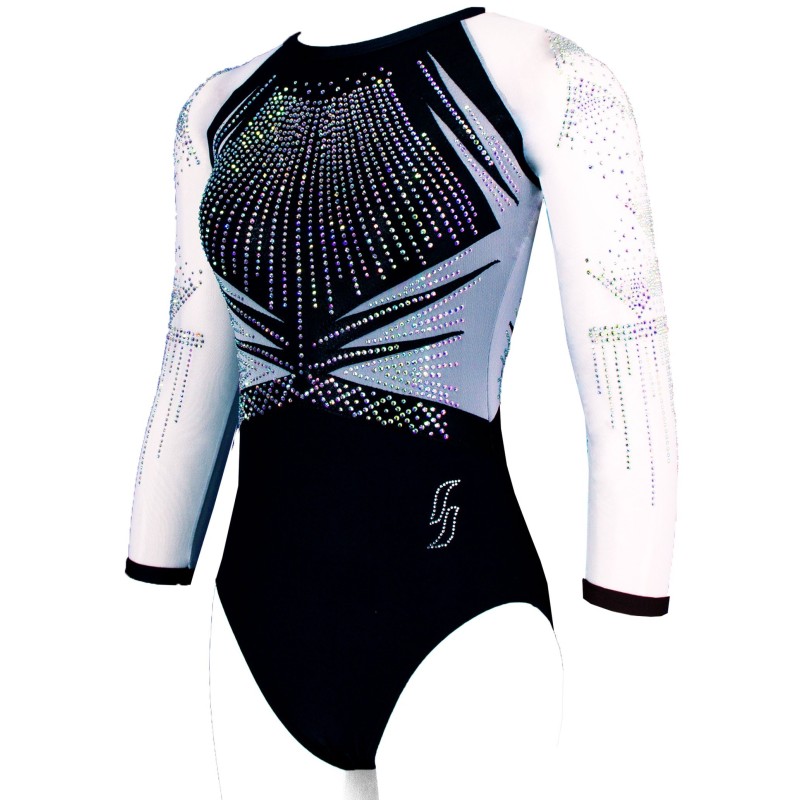
How do you work out your clothing size?
A clothing size is not something you measure: you first take your body measurements, then compare them with the size chart for the specific manufacturer and model. A leotard size chart may list sizes 34, 36, 38, 40 and 42 as well as XS to XL, each with its own measurement ranges. The same size letter does not necessarily stand for the same body measurements from one manufacturer to another.
Torso length shows this particularly clearly. A chart might give ranges of 130–140 cm, 135–145 cm and 145–155 cm, which only apply within that chart. Likewise, a torso length of 115 cm cannot be converted directly into a standard clothing size. DIN EN ISO 8559-1:2021-04 defines body measurements and measuring principles for developing sizes, but it does not replace a leotard size chart.
Judging the fit correctly
Close-fitting, stretchy leotards hug the body. Their circumference when worn therefore does not simply match the flat-measured dimensions of the finished garment; cut, fabric and body proportions all play a part.
There is no universal measuring tolerance in centimetres for choosing a size. If you fall between two sizes, one sizing guide recommends going for the larger one. Startner offers simple styles in many colours, both in its range of personalised competition leotards and for everyday training.
What does “armpit to armpit” mean?
“Armpit to armpit” is the width of a garment laid flat, measured between the underarm or side-seam points. Doubled, this figure gives an approximate width of the garment, not your bust measurement.
A leotard that already fits you well makes a good comparison. Lay it flat and also measure diagonally from the shoulder to the crotch.
Tip
Check your measurements against the model’s chart
Always compare your bust, waist, hips and, for one-piece leotards, your shoulder-to-crotch measurement with the size chart for the specific model, not with the label.
Recording measurements for made-to-measure club leotards
For a club order, measurements are collected from many gymnasts. A carefully kept measurement sheet makes every size decision easy to trace later on.
Gathering the details you need
For club orders and custom-made pieces, what counts are the body measurements the manufacturer requires for the cut and the choice of size; a size label alone does not capture them. A measurement sheet can include the following fields:
- Body measurements: bust, waist and hip circumference, plus further torso and leg measurements if needed, all in centimetres.
- Manufacturer and model: the cut chosen.
- Notes: comments on borderline cases between two sizes.
Only this combination of figures and context explains why a gymnast is given a particular size.
Measuring consistently and checking the fit
Within a club, measurements can only be compared if everyone is measured using the same method and at the same points. Ideally, the same person takes all the measurements.
So add the measuring date and the name of the person measuring to the sheet. Also note which measuring points you used, such as the waistline chosen.
Before placing the group order, sample leotards offer a practical check: fit shows on the body, not on paper.
Using the measurements for personalised club leotards
Startner makes customisable gymnastics wear for artistic gymnastics and rhythmic gymnastics, and provides a choice of fabrics as well as order documents for club orders. Your complete measurement sheet can be used for these documents.
For a uniform look at competitions, the collection of custom club leotards features styles in your own colours, with rhinestones and club logos.
Club leotards made to your measurements
Using your measurement sheet, we make custom leotards for your club, in your club colours and with your logo, using technical Lycra fabrics produced in France.

Frequently asked questions
A correctly taken body measurement does not guarantee the right size on its own. The cut, stretch, fabric, your body proportions and the manufacturer’s size grid can all affect the fit.
DIN 33402-1:2008-03 covers terms and measuring methods for body dimensions. DIN EN 13402-3:2017-12 describes a sizing system based on body measurements and size increments. ISO 8559-2:2025 sets out primary and secondary measurements, and ISO 8559-3:2018 covers the development of measurement tables and size intervals; these standards do not specify the dimensions of finished garments.
Share this article:





Similar posts
Size 26 for children: measurements and gymnastics leotard fit
What does size 26 mean for children's sportswear and gymnastics leotards? Startner explains size charts, body measurements and freedom of movement so you choose the right fit.
Women's gymnastics leotard size chart: how to measure
Bust, waist, hips: how to measure correctly and choose a gymnastics leotard in the right size using the size chart for each style.